

High fantasy of the 1970s was far more creative, dark, surreal, and whimsical than the fantasy that preceded it in the previous decade. One might look back to this period as the time when high fantasy imagery — dragons, wizards, and faraway kingdoms — was closely overlapping with both hippie idealism and heavy metal theatricality. This was, after all, the era in which hippies wore “Frodo Lives” buttons on the street and Deep Purple fans painted dragons on the sides of their vans. High fantasy, in terms of its pop cultural impact, was leaking in around the edges. Kids started to play “Dungeons & Dragons” on a more widespread basis, and magical wizards began appearing more and more frequently on Saturday morning television.
Several marvelous fantasy features also hit the big and small screen in this decade. Most studios weren’t willing to pour giant budgets into fantasy films just yet, so many of the more notable classics of this era are animated. Indeed, thanks to the rise of New Hollywood, some of the more notable Hollywood productions of the decade are downbeat, adult dramas. There’s a reason the 1970s is associated with directors like Martin Scorsese, Francis Ford Coppola, Robert Altman, and Stanley Kubrick. These filmmakers were very adult and made movies that dealt frankly with human foibles, crime, and violence.
Lightweight fantasy films from the 1970s are less well-known. The below movies, however, show that the decade was still ripe with magic and fun. Indeed, one can sit their kid down in front of any of these films, even in the 2020s, and enjoy their sparkling ideas and faraway worlds. Everyone should watch these movies at least once.
The Phantom Tollbooth (1970)
Based on the young adult novel by Norton Juster, “The Phantom Tollbooth” was an animated movie directed by Abe Levitow and the legendary Chuck Jones. It was bookended by two live-action sequences directed by Dave Monahan and followed the adventures of Milo (Butch Patrick), a young boy who’s alone in his apartment and bored out of his wits. A magical box then sails into his window and unwraps itself, revealing a small car and a full-size tollbooth. Milo then proceeds to drive through the tollbooth and finds himself in an animated world constructed of … concepts.
Milo enters the kingdom of numbers and the kingdom of letters. He drives into a swamp filled with the Doldrums … which leave him in the doldrums. He befriends a talking dog with a watch in his body — a watchdog — voiced by Mike Davis, and a lying six-foot insect called the Humbug (Les Tremayne). It seems that a pair of fairies, Rhyme and Reason, have been expelled from this kingdom, and Milo has to traverse difficult, self-defeating ideas to rescue them. The film is whimsical in a Lewis Carroll sort of way, relying on puns and wordplay for all its visual gags. There is a Spelling Bee, a Whether Man, and a certified Which.
But it’s also intellectual. “The Phantom Tollbooth” uses its fantasy setting to explore the way one intellectualizes the world, including their own emotions. It’s also a cry for thought and creativity in a world racked by boredom. Overall, it’s a film for nerdy little kids (and nerdy little kids, you’ll find, are legion).
The Golden Voyage of Sinbad (1973)
Gordon Hessler’s “The Golden Voyage of Sinbad” is one of dozens of films inspired by Sinbad the Sailor, the character from “A Thousand and One Nights.” Most of these movies are more concerned with fantasy images and adventure than they are with literary fidelity, but each one, at the very least, attempts to capture the adventurous tone of a work of ancient Middle Eastern literature. These films tend to be a mishmash of various works of fantasy lit and religious folklore. If they were made in the West, they also tend to feature white European and American actors playing Middle Eastern characters. That element certainly hasn’t aged well.
But the raucous fun is still present. The special effects in “The Golden Voyage of Sinbad” were provided by animation legend Ray Harryhausen, and one might even be familiar with the sequence where Sinbad (John Philip Law) has to fight a living statue of Kali. The story of “Golden Voyage” is a freewheeling, picaresque narrative inspired by Sinbad and his fellow sailors finding a magical golden amulet. This leads him to confront an evil wizard named Koura (Tom Baker) and into the company of a comely princess named Margiana (Caroline Munro). “Golden Voyage” feels like dreams come to life, a wild, exciting children’s fantasy translated through both the lens of literature and the dazzling effects of a high-end Hollywood production. Fun trivia: Evidently, Tom Baker’s performance in “Golden Voyage” was so impressive that a “Doctor Who” producer reached out to him about playing The Doctor. He landed one of TV’s most notable roles because of this movie.
The Twelve Tasks of Asterix (1976)
Asterix comics — created by René Goscinny and Albert Uderzo — are incredibly well-known in their native France, but they don’t have nearly as large an audience in North America. It’s time to change that, and a great entry point to Asterix may be the 1976 animated film “The Twelve Tasks of Asterix.” The original comics are set in Gaul in 50 B.C.E., when the nation was entirely occupied by the Roman Empire. Well, not entirely. A single Gaulish village on the northern coast managed to hold out against the Roman invaders thanks to the fighting prowess of their chief warrior Asterix and his best friend, the naive and powerful Obelix. Oh, and they also have a local druid who brews them a magic potion that gives them superhuman strength and invulnerability. The Gauls are lusty, fun-loving, big-eating buddies, while the Romans are wimpy, bureaucracy-obsessed ninnies.
The plot of “Twelve Tasks” is fun: Caesar, tired of the Gauls, decides to test if they might actually be gods by inventing a new list of Herculean tasks for them to accomplish. If Asterix and Obelix can complete all 12, then Caesar will cease fighting them.
The tasks start out pretty straightforward — out-race Rome’s fastest runner, out-throw a Persian javelin champion — but get more surreal as the film goes on. One challenge involves eating everything in a chef’s kitchen, while another is to enter the Central Bureaucracy and get a form stamped. The film climaxes in the Circus Maximus.
“The Twelve Tasks of Asterix” is a slapstick comedy for history buffs and is full of Latin wordplay and obscure historical references. Talk about nerdy. What bliss.
The Hobbit (1977)
Much ink has been spilled over the six feature films that Peter Jackson has directed inspired by the Middle-Earth novels of J.R.R. Tolkien. Jackson’s “Lord of the Rings” and “Hobbit” movies are long, epic, sweeping, and full of fantasy details that are derived from book illustrations. They’re also (if I may risk my entire critical reputation) merely okay. Jackson was a much more interesting filmmaker when he was shooting films about hungry zombies or puking puppets. His large fantasies feel like a mere baseline reading, not a bold new take on Tolkien’s material.
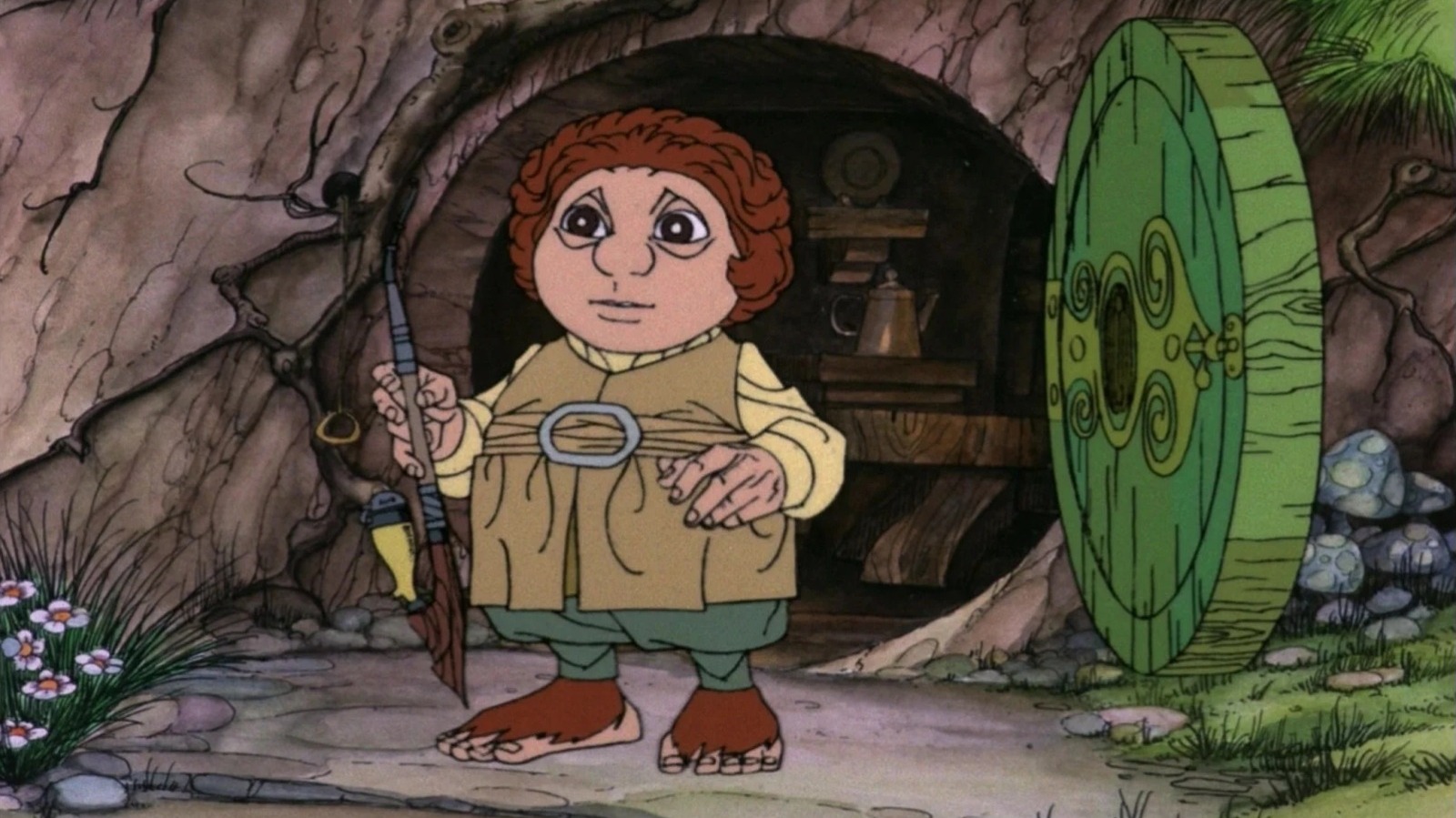
But Arthur Rankin, Jr. and Jules Bass’ 1977 animated film version of “The Hobbit” was. It employed a unique, thin-line design that doesn’t resemble any movie that came before or since. Bilbo Baggins (Orson Bean) was a wide-eyed homebody in this film, more believable as a creature of comfort than any rendition of the character since. He is asked by a dozen dwarves to help them trek to Lonely Mountain, where a dragon named Smaug (Richard Boone) has stashed away all the Dwarven gold. The voice cast includes famous film directors — John Huston plays Gandalf, Otto Preminger plays the Elf King — as well as many well-known animation luminaries, including Don Messick (Scooby-Doo), Thurl Ravenscroft (Tony the Tiger), Paul Frees (the Haunted Mansion), and Hans Conried (Disney’s Captain Hook).
The soundtrack is provided by folk singer Glenn Yarbrough, whose song “The Greatest Adventure” will stick in your head. It also lends “The Hobbit” a placid, pastoral vibe that makes the film at large weirdly relaxing. That is, until you see the goblins, which are terrifying. This film also has cinema’s best Gollum (Brother Theodore), imagining him as a lamp-eyed newt creature. All credit to Jackson, but the Rankin/Bass movie will always have my heart.
KISS Meets the Phantom of the Park (1978)
It’s kind of a marvel that the rock band KISS wasn’t in more feature films. Their look and music was so dramatic and theatrical, they would fit well into any fantasy movie. Indeed, the band’s stage personae warranted a larger canvas, as they came packaged with a broad fantasy narrative and exciting pseudonyms. Gene Simmons was The Demon. Paul Stanley was The Starchild. Ace Frehley was The Spaceman. Peter Criss was The Catman. They are heavy metal superheroes, complete with costumes and facial makeup. Travelers from a fantasy dimension. They should be fighting robots or something.
In the 1978 TV special “KISS Meets the Phantom of the Park,” they were permitted to do just that. It was one of only a few film projects that KISS was involved with, but it made full use of their stage personae. It also resembled an episode of “Scooby-Doo,” complete with all its simplicity and silliness. The film was about an evil robotics engineer (Anthony Zerbe) that had created a bunch of realistic animatronics for Six Flags Magic Mountain (and the film was shot in the actual park in Valencia, California). When he gets fired for implanting raucous punkers with mind-control devices (!), he blames KISS, who’ve just arrived for a park concert. In this world, KISS is never out of costume, and its members all have superpowers. Simmons can breathe fire, for instance. Zerbe’s engineer then creates robot clones of KISS and force them to fight. KISS, obviously, wins the day in the end. Valencia Rock City.
Is this ridiculous? 110%. “KISS Meets the Phantom of the Park” is as absurd and nonsensical as it sounds. But it’s also wildly entertaining. Gather friends, have some drinks (if you’re of legal age), and enjoy.
Source link
